Wood Tractrix horns will no longer be available directly from ALK Engineering. The Trachorns have always been made by Bill Martinelli of woodhorn.com. Mr. Martinelli has moved on to other endeavors and will no longer be making them.
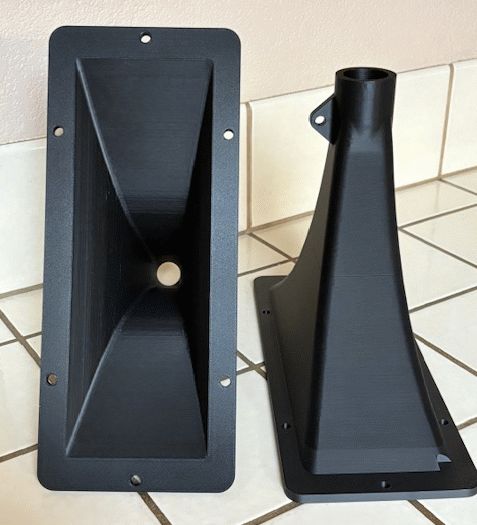
Dave Harris of Fastlane Audio and ALK Engineering have collaborated to develop a new series of 1-inch and 2-inch wood tractrix horns comparable to the Martinelli Trachorn for all of the Klipsch heritage series speakers.
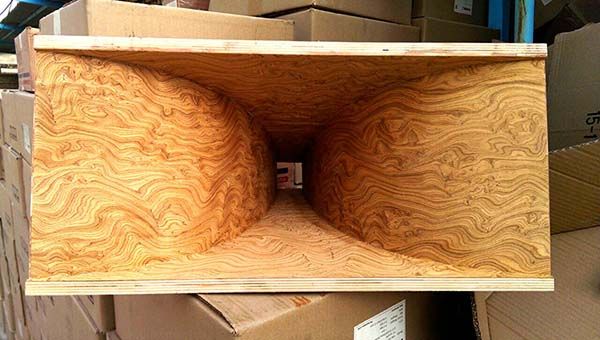
Like the Martinelli Bruce Edgar type Trachorn, the Fastracs offer thick curved sides made form two separate layers of wood glued and screwed together for total damping.
All the Fastrac horns are compatible with the original Klipsch crossover networks, but once you experience the improvement in sound quality these horns deliver you will find a new love for your heritage Klipsch speakers and will want to move on to fix the other big shortcoming, the networks!
On the right is a grill frame from a Belle Klipsch. It's the K500 squawker horn, K55V driver and "Z-bracket" K77M tweeter. A frame out of a Klipschorn, on the left, looks the same except everything is a little bigger. It uses the K401 horn and K55M driver instead. Both frames are held to the sides by 4 long screws. The screw positions are marked by red arrows in the pictures. Remove those 4 screws and the entire thing slides out the front! They are very easy to remove and replace.
The 1-inch Fastrac K:
The 2-inch Fastrac K2:
The 2-inch Eliptrac 400:
The Eliptrac 400 is an elliptic Tractrix 2-inch horn for the Khorn. The design is pure wood tractrix and will fit in the same grill frame as the Trachorn 400, 420 and the Fastrac K or K2 Bruce Edgar type horns.
More on the Eliptrac 400
A universal adaptor for 1 and 1.4 Inch drivers that maintain the correct tractrix expansion without compromise is also available. Here's the details.
DIYers: Do you want to save some money? Do you know how to use a file and a sheet of sandpaper? This horn is made form machine-cut layers of wood each held in position with pegs. It is available in kit form. Just glue the layers together and sand them smooth! LOOK!

Enlarge
* For the LaScala *
A horn designed specifically for the LaScala has the same mounting hole as the stock K400 horn. No cutting of the woodwork is required. The Fastrac LaScala also features an airtight front flange making it the ideal horn for use in speakers like the CornScala that have the midrange horn mounted within the woofer area. More on the Fastrac LaScala
* For the Belle Klipsch *
The Belle horn will be offered with a replacement grill frame to replace the K500 horn in the Belle Klipsch without the need for risers. It is very similar to the LaScala horn but with a front flange suitable for mounting in a frame or a simple cut-out. Fastrac Belle (Available now)
The Fastrac LaScala horn does not go quite as low as the stock K400 but is safe to use with the stock K55 squawker driver. Although drivers such as the JBL 2426h will fit this horn with no modification to the horn, network change will be needed to use them. The crossover frequency of Belle Klipsch or LaScala would need to be raised to 500 Hz. The AP12-500 or ES500 and ES5800 set is suggested.
Enlarge
The real reason to move to a 2-inch horn is to allow a better driver than the stock K55 to be used. This is why a 2-inch horn is being suggested, not to extend the lower limit of the midrange! There is simply no 1-inch driver that will do! The B&C DCM50 driver is being offered for 2-inch horns. It was designed for the 400 Hz crossover required by the Khorn.
Click HERE for a complete discussion comparing 1 and 2 inch horns.
STOP THE MUSIC! UPDATE: The discussion above is several years old. Since then the cost of 1-inch drivers that will reach down even to 500 Hz have become more expensive as trends are moving 1-inch drivers to higher recommended crossover frequencies. The quality 1-inch driver used in the IM distortion plots is the JBL 2426h. Prices on this driver have gone up to roughly $400 each! This is making 2-inch drivers a very reasonable alternative for the Belle Klipsch, LaScala and even the CornScala!
The most appropriate 2-inch mid-range driver, the B&C DCM50
ALK suggests the B&C DCM50 2-inch driver which is an ideal driver for use in the Klipschorn. These are designed for the 400 Hz crossover required by the Khorn. ( Set of two drivers: $910.00 ) Larger drivers designed to go lower provide no advantage and simply cost more! No known 1-inch driver can replace the stock K55V without distortion. This should not imply that a K55 driver should be jury rigged to the throat of a 2-inch horn. This creates a major discontinuity in the throat.
NOTE: If you do decide to replace the K55 with a better driver you should realize that your "stock" Klipsch network will no longer be usable. All of them depend on the natural roll off of the K55 at 6000 Hz to form the crossover. Very few quality drivers do this. They usually operate far higher. This means the squawker and tweeter will both be making a sound simultaneously. Better drivers will normally be louder too. Only the networks from ALK Engineering will do.
A Coaxial option, the B&C DCX50!h>
(Click picture to enlarge)
B&C offers a coaxial version of the DCM50 driver that has a tweeter mounted directly in the center of the throat that extends its range to 16 KHz. It is the B&C DCX50 . It looks identical to the DCM50 but has an extra set of push-pin connections for the tweeter section. The advantage is that the mid-range and tweeter are time aligned allowing the advantages of the 4th order Linkwitz-Riley network at 9 KHz to be realized. Time alignment means that an extreme-slope network is not required. The network is the LR24-9000.
The LR24-9000 Linkwitz-Riley network
This network was designed specifically for the B&C DCX50 coaxial driver for a time-aligned Khorn top end. It works well with the Eliptrac 400 Elliptical tractrix horn available from FastLane audio but should be compatible with any horn which does not obstruct the throat off axis. The high 9000 Hz, 24 dB / octave crossover to the concentric tweeter comes as close as you can get to the 2-way speaker Paul Klipsch wanted in a 3-way system. This combination yields the best stereo image possible because it is phase coherent and so high in frequency that the tweeter just adds "crispness" to the sound without upsetting even the lower treble region. You will not need a center channel speaker! An attenuator for the tweeter is included to allow the tweeter level to be adjusted up or down to taste. The normal setting is -3 dB. Impedance when operating into the DCX50 driver is a flat resistive 6 Ohms easily driven from 4 to 8 Ohms sources. The network is available separately (Set of two: $399.00) but is also offered as a package with the DCX50 coaxial driver it was designed for (Set of two: $1550.00).
Since the development of the AP12-9000 network and coaxial DCX50 combination several drives have been found that will provide a true 2-way system with the 400 Hz crossover required by the Khorn woofer. One is the Faitel Pro HF200, another is the B&C DE85TN. Both have low distortion and frequency response to well beyond the hearing range of most of us. The DE85TN has just slightly higher distortion then the DCX50 at 400 Hz. It is available directly from ALK Engineering. ($540 for a set of two)
Woofer / squawker network: Either high frequency setup you choose must be crossed over from the Khorn woofer at about 400 Hz. The recommended low frequency network is the ES400 strapped for 2-way operation, but the AP12-350, AP12-AK3 or the high-frequency amplifier of a bi-amp setup are options. The stock Klipsch crossover networks are NOT suitable.
It's easy: Click the picture for details
All of the crossover network combinations from ALK Engineering are compatible with true 2-way or 3-way operation by removing a single strap. A simple switch can even be used in place of the strap to select between 2-way and 3-way operation in seconds if you have a conventional tweeter. The diagram at the left shows how the orange 3-wire cable provided with the squawker / tweeter (high frequency) networks (ES5800, AP15-6000 etc.) can be connected to make the change on a whim!
The transformer located on the woofer / squawker (low frequency) network will remain to set the level of the wider range driver in the 2-way switch position! The tweeter will simply make no sound. All you need to make this work is a driver like the HF200 that is capable of operating all the way up to tweeter frequencies.
Compare Intermod distortion: DCM50, HF200, DE85TN
ALK Engineering is a authorized B&C dealer. B&C has an extensive line of horn and driver products. Here are some wide-range drivers you might consider:
(Note that B&C plots the response of their drivers on a 5dB/division scale rather then the usual 10dB/division. They are a lot smoother than the plots suggest!)
Contact us for pricing.
There remains a debate between a 2-way system or a 3-way system as to which sounds better. In our experience, a 3-way system using extreme-slope crossover networks yields the best results. The mid-range horn required in a 2-way system simply can't handle the highs as well as the smaller horn of a tweeter designed specifically to be a tweeter. The choice of what tweeter driver and horn then becomes the issue in a 3-way system.
The stock K77 tweeter should be the last item on your upgrade list. It is not a bad tweeter but can be easily damaged. There are better tweeters available. Here are several to consider.
The CT-125 from Bob Crites is an excellent tweeter for use with the Universal network. It has slightly lower sensitivity than the stock K77 and will not require an external attenuator. It will also directly replace the K77 with no modifications.
The recommended combination is the B&C DE10 driver on the Fastrac Contrac hybrid horn. The DE10 driver yields the smoothest response we have seen between 6000 and 16000 Hz. This is the critical range between a 6000 Hz crossover and the upper limits of hearing for most of us. The Contrac horn is a marriage of conical and tractrix expansions. The intermodulation distortion is extremely low even at very high levels. The DE10 driver is available from ALK Engineering. (Set of two: $90.00)
The B&C DE10 tweeter with the B&C ME10 horn is also available directly from ALK Engineering (Set of two: $115.00) .
Measured performace with ES5800 crossover.