
PCFILT
Many years of development by two hands-on engineers who appreciate the practical side of filter development, not just the engineering side, combined with a 6 month "Beta-test" involving 10 copies of the package in the harsh environment of a major filter company attest to fact that PCFILT is accurate and bug-free. You won't find a need for a Masters degree in network synthesis to design filters with PCFILT, just enough experience to know what kind of filter you want. You won't find a lot of glitter and "eye-wash" either. What you will find is the fastest and most convenient integrated design and evaluation environment for filters available at any price. There is nothing else to buy, even the network analysis and optimization programs are internal and always available. The user interface has been developed to provide the designer with an operating scheme that represents a new standard in flexibility, speed and power.
The beginning user will find a menu-driven scheme for the design of all of the most common filter types with help screens on each menu to lead the way. In a short time, the power and internal sophistication of the program will become obvious allowing the design of extremely sophisticated networks with an order of ease and flexibility that will amaze you. You will find no other program available that can compare!
Examine the sample screens or
Jump right to the official specs and capabilities

PCFILT has a built in network analysis module with a graphics plot featuring fully automatic scale factors in a 1-2-5 sequence just like a network analyzer. No mental arithmetic is needed to read the frequency scale! The plot can display attenuation, group delay, phase linearity, a Smith chart and one extra plot which can be voltage, current, loss or simple impedance. These can be displayed individually or all at once.
9 definable fixed frequency markers (F1, F2 ...) let you quickly move the marker to a specific point to check critical specifications.

Filters can be designed separately and joined together in series with one another or with one end of each all in common to form a multiplexer. You can quickly select which channel to "look through" with analysis by selecting the channel with the circuit editor just as you would switch the cables between the channels on a real network analyzer.

Of course, PCFILT designs a staggering variety of filters quickly by simply scaling them from the large variety of normalized reference lowpass filters provided. You could use Chebyshev or Gaussian to 6 dB or a lot of others, but then, most of the other programs available do that. PCFILT is different because it will scale ANY filter from ANY type of lowpass reference including those from its own internal reference pole placer.
Just think, a capacitively coupled resonator filter with stopband notches added anywhere you want them. You won't have to optimize it either! PCFILT even goes one step further. It can actually synthesize bandpass filters directly to your specifications WITHOUT scaling them from a lowpass filter. This means a perfectly equal ripple passband with any number of stopband notches anywhere you want them. The plot above even shows the specification
mask that was used with this example.

Another nice utility you might need is Fourier analysis in the time domain. PCFILT let you see the output of any filter when its input is hit with a spike, a square pulse with any duty cycle up to 99% or a gated RF carrier. The response of a typical Chebyshev lowpass filter with a square input pulse is displayed.

A common type of filter that can be quite difficult to design is the coaxial "tubular". Getting the right coupling thickness and wire lengths can be quite difficult. This is an easy job for PCFILT. It even makes all the slugs equal to whatever size you specify and shows you the assembled filter to exact scale.

Have you ever wanted to know where the worst case voltage or currents will develop in a filter when it has to handle a high power level? PCFILT will show you the voltage and current levels at any place in any filter with any termination VSWR and over any frequency range. You can even plot the voltage, current or losses at any point in the filter across any frequency range! A plot of the voltage at the top of a resonator in a typical combline
filter is displayed here.
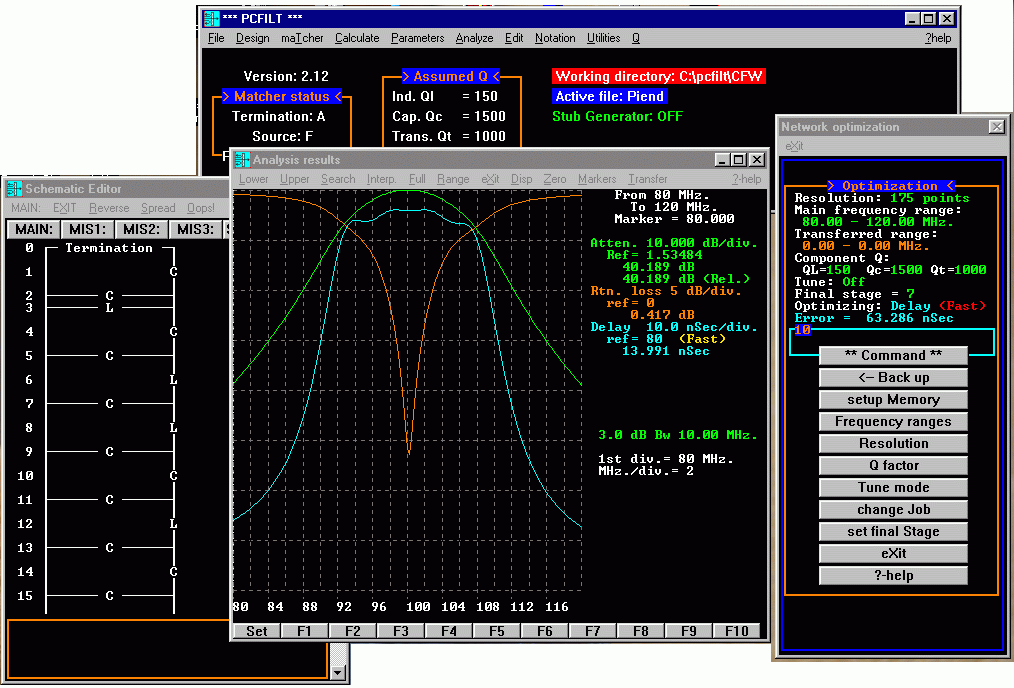
Sometimes you will need to touch up a design. PCFILT offers an internal optimization modules that will optimize on the part or parts of your choice to improve return loss or flatten group delay or amplitude. A "tune" mode let you try values you like at any branch or step the value up or down using the keyboard. Above, a 10% bandwidth linear phase filter is being optimized for flattest group delay.
SYSTEM REQUIREMENTS:
- Windows 95 or later.
- Windows XP or later will require a free software driver to interface with the hardware key (provided, or which may be downloaded from our home page). Windows 95 and 98 do NOT require the driver.
- One USB port for the key.
- Hard copy print-outs of designs can be made on any printer regardless of age.
- The software is distributed on a single compact disc (CD).
GENERAL:
The program consists of many object modules written in "C", compiled and linked together creating a single executable program.
CAPABILITIES:
- On-line network analysis of attenuation, group delay, absolute phase, phase linearity or return loss. Forward voltage, current or loss at any point in any L-C or transmission line design can be tabulated or plotted for any input power level and load VSWR. Automatic "maximum survey" looks for the worst case voltage, current and loss levels throughout a network.
- Simultaneous graphic or tabulated display of any 4 parameters with 10 programmable fixed frequency markers. Save and recall of up to 9 analysis runs either as graphic displays or tabulated data. Graphic display scale factors are fully automatic with a logical 1-2-5 vertical sequence and a horizontal frequency scale that requires no mental arithmetic to decipher. A movable marker allows numeric data to be displayed for any point on the curves. A Smith chart is also provided to display complex input Zo.
- Independent selection of the desired filter and the lowpass from which it is scaled allows tremendous flexibility in L-C direct scaled designs as well as narrow-band approximations.
- A Full-featured circuit editor with conventional command line edit mode (DOS version only) or mouse point-and-click mode with instantaneous display of changes and forward or backward schematic scrolling. Some of the many editing capabilities include: Change value, Norton transform, Interchange two branches, Kuroda identities, split, combine or delete branch, scaling for impedance or frequency, part value forcing, coupled triplets, L-C to and from transmission line stub conversions, an "OOPS" feature to back up after mistakes
and much more.
- Fast graphic network optimization of return loss, group delay or amplitude flatness with 7 store and recall setups, on line analysis and circuit editing from the optimization menu. A "Tune" mode to experiment manually with different values at any branch is also provided.
- Fourier impulse analysis with pulse duty cycle adjustable from zero to 99.5% on any design. Gated RF or "base-band" response using envelope or ringing frequency display "time base".
- Series or multiplexer joining of any networks including equalizers or transmission line filters in any channel. Floating common junctions allowing entire multiplexers to be series joined with other networks or transmission line filter multiplexers with resonators in common.
- Point-and-click selection of any multiplexer channel for individual forward analysis.
- A programmable transmission line stub generator to convert L-C branches in any design to stub equivalents automatically during the design and continuous tabulation of microstrip line widths and lengths if desired.
- File conversion utilities for Touchstone(R) and Spice analysis.
SPECIFICATIONS:
- TRANSMISSION LINE CAPABILITY:
- Bandpass filters:
- Combline or Interdigital
- OCTL, SCTL transformed, series C or tap matching with capacitive loaded resonators (variable electrical length).
- Singly or doubly terminated.
- Equal or floating resonator sizes.
- Precise mechanical dimensions including spacings for rectangular or round resonators with end-wall compensation down to .05 times ground plane spacing.
- Reactance coupled (L or C) coaxial dielectric resonator.
- Equal resonators with tuning capacitors.
- Unequal resonators WITHOUT tuning capacitors.
- Wideband direct connected.
- Notch filters:
- Wideband coupled stubs.
- Kuroda transformed narrow bandwidth designs including mechanical dimensions for:
- Microstrip stubs.
- Parallel coupled rectangular resonators.
- Spur lines.
- Capacitively coupled narrow band stubs.
- Microstrip:
- An interactive utility calculates (uncovered) microstrip line dimensions for any compatible L-C design while simultaneously allowing parameter changes,analysis and optimization.
- Etc.
- LUMPED COMPONENT DESIGNS:
- General:
- All designs (even narrow-band reactance coupled) may be scaled from any type lowpass reference desired including:
- Chevyshev
- Butterworth
- Elliptic function
- Normalized k&q or "G" values
- A normalized external free format lowpass filters you have input and saved yourself.
- An exact synthesis lowpass filters via internal manual or automatic pole and zero placer and pole remover.
- A disk based catalog of special responses including: Bessel, Gaussian, etc. (both with symmetrical and asymmetrical values). Menu selectable.
- Any design including all-pole (Chebyshev or Butterworth), pole placer and elliptic function designs may be singly or doubly terminated.
- All-pole lowpass references synthesis between arbitrary impedances.
- Elliptic odd order or even order type "B" or "C" (equal terminations).
- Automatic programmable impedance matcher allows independent choice of load, source, and internal impedance for bandpass filters.
- Etc.
- Bandpass filters:
- Narrow band approximations:
- Any combination of mesh, node or direct scaled "sections" in any order, operating automatically using "j", "k" or "notch" inverters scaled from external reference lowpass filters as well as internal zero placed or all-pole values. Equal shunt value forcing on most designs including elliptic function designs. L or C couplings at any position.
- Equal shunt "tubular" circuit with accurate mechanical dimensions for coaxial realizations compensated for slug fringe capacity, coaxial line gap discontinuity on couplings, "case" effects on wire lengths and "Pi end slug" matching for narrow bandwidths. "slug" sizes may be specified directly (See RF Design, March 1994, page 114).
- Direct scaled designs:
- LPBP, minimum component and forced shunt transformed direct scaled designs from any reference filter including pole placer with continuously tabulated display of element values. Menu selected editing and parameter changes.
- Narrow bandwidth elliptic function bandpass filters with realizable element values down to the limits of component Q by iterated Norton transforms (See RF design, December 1992, page 25).
- Exact bandpass synthesis (conventional):
- Bandpass pole and zero placer
- Manually place zeros at any frequency.
- Automatically place zeros to specification mask.
- Automatic or manual pole and zero removal by standard "sub-section".
- Single or double terminated.
- Etc.
- Notch filters:
- Wideband direct scaled (highpass to notch) filters from any lowpass reference.
- Narrow bandwidth (Geffe) transformed designs.
- All-pole or Elliptic function.
- Totally L-C or with transmission line isolated sections.
- Notch can have lowpass or highpass passbands.
- Equalizers:
- Equalize amplitude or group delay.
- Continuous graphic display of results.
- Automatic operation by least-squares error.
- Manual operation by mouse point-and-click.
- Equalize:
- Analyzed data from a computer design.
- Measured data on an existing filter.
- To a tabulated specification.
- Resistor pads:
- Minimum loss "L" pads.
- "Tee" or "Pi" attenuators.
- Etc.
Go to ALK Engineering home page